2025 Food Recall Statistics: What Was Recalled Most This Year
By the EatSure teamPublished 3 min read
On this page
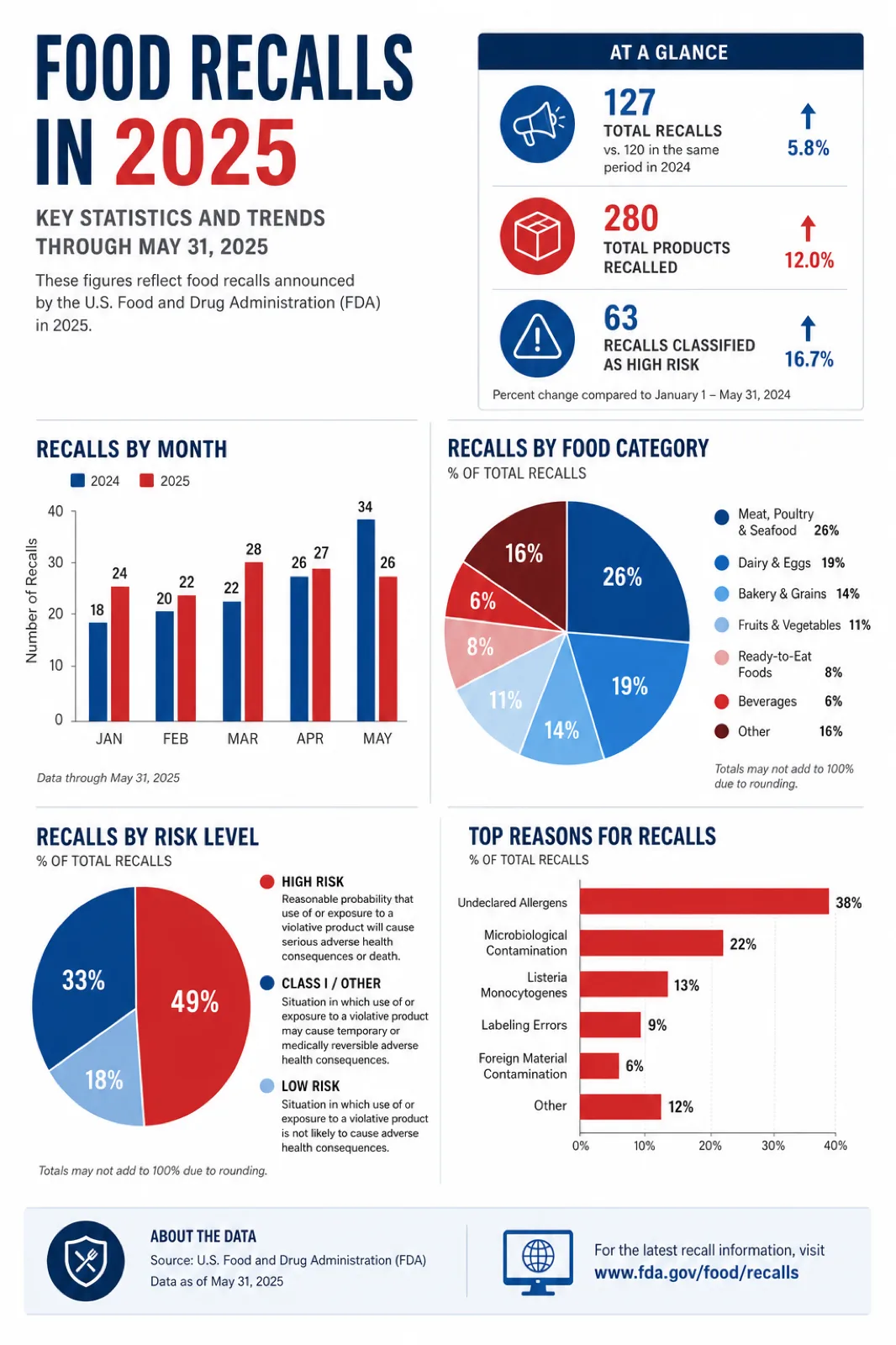
Every time you grab a snack from your pantry or cook dinner for your family, you trust that the food is safe. But in 2025, that trust was tested more than ever. According to combined FDA and USDA data, an estimated 613 food recalls were issued in 2025 — a 20% increase over the 505 recalls recorded in 2021 (Source: Trace One 5-Year Analysis).
That's roughly 12 recalls per week. Chances are, at least one product you bought this year was affected.
This article breaks down the most important 2025 food recall statistics, what was recalled, why, and what you can do to protect yourself and your family.
2025 FDA Food Recall Numbers: The Big Picture
The FDA recorded 251 food and beverage recall events in 2025 — averaging about 5 new recalls per week, according to analysis published by Esko/GlobalVision.
On the USDA side, the Food Safety and Inspection Service (FSIS) issued 42 recalls covering a staggering 71.4 million pounds of meat, poultry, and processed food products. Of those, 38 recalls (90.5%) were classified as Class I — the most serious category, meaning there is a reasonable probability that eating the product could cause serious health problems or death.
What Caused the Most Food Recalls in 2025?
The causes of food recalls in 2025 fell into a few major categories:
Allergen Mislabeling — 45.8% of FDA Recalls
The single biggest driver of FDA food recalls in 2025 was undeclared allergens, responsible for 115 out of 251 FDA recall events. Milk and dairy were the most common undeclared allergen, accounting for roughly 30% of all allergen recalls. Tree nuts, wheat, peanuts, sesame, and soy rounded out the list.
Foodborne Illness — 37.5% of FDA Recalls
Contamination by dangerous bacteria caused 94 FDA recall events. The breakdown:
- Listeria monocytogenes: 42 recalls
- Salmonella: 35 recalls
- E. coli and C. botulinum: Remaining recalls
Salmonella was the most common cause of foodborne illness outbreaks in 2025, linked to 63% of outbreaks. However, Listeria caused the greatest number of outbreak-related deaths — a sobering reminder of its lethality, especially for pregnant women, the elderly, and immunocompromised individuals (Source: FDA; CDC).
Chemical and Radiological Contamination — 10.4%
A surprising 26 FDA recalls involved chemical or radiological hazards. Notably, a cluster of 11 separate recalls stemmed from Cesium-137 contamination found in frozen shrimp products.
Foreign Objects — 3.6%
Nine FDA recalls involved foreign objects including plastic fragments, stones, glass, metal, and wood. On the USDA side, foreign material contamination was the #1 cause, responsible for 13 of 42 recalls.
USDA Recalls: Meat and Poultry by the Numbers
The USDA's 42 recalls in 2025 covered an enormous volume of product:
- Foreign material: 13 recalls
- Undeclared allergens: 9 recalls
- Production without inspection: 7 recalls
- Import violation: 5 recalls
- Listeria monocytogenes: 4 recalls
- Unapproved substance: 2 recalls
- STEC (E. coli): 1 recall
- Misbranding: 1 recall
How 2025 Compares to Previous Years
The upward trend in food recalls is unmistakable:
- 2021: 505 total recalls — baseline year
- 2024: 296 total recalls (FDA+USDA confirmed) — 1,392 people sickened
- 2025: ~613 total recalls (estimated) — 20% increase over 2021
Class I recalls — the most dangerous — grew by 36.4% over the 5-year period, outpacing Class II (11.2% growth) and Class III (17.1% growth) (Source: Trace One Analysis).
What This Means for You
These are not just statistics — they represent real products on real shelves. In 2024 alone, 1,392 people were sickened by recalled food (Source: PIRG Food for Thought 2025). The 2024 Boar's Head Listeria outbreak killed 10 people across 18+ states (Source: USDA FSIS). The October 2024 BrucePac recall covered approximately 12 million pounds of ready-to-eat meat — one of the largest in history.
If you're only hearing about recalls from the news, you're probably missing most of them. Five new FDA recalls per week means the vast majority never make headlines.
How to Stay Ahead of Food Recalls
- Check the FDA and USDA recall databases regularly.
- Sign up for recall alerts to get notified as soon as a new recall is issued.
- Use a recall tracking app like EatSure.
- Scan your grocery receipts.
We track every one of these recalls in real time. Download EatSure to see if anything in your fridge has been recalled.