Food Recalls by State: Where Are You Most at Risk in 2025?
By the EatSure teamPublished 4 min read
On this page
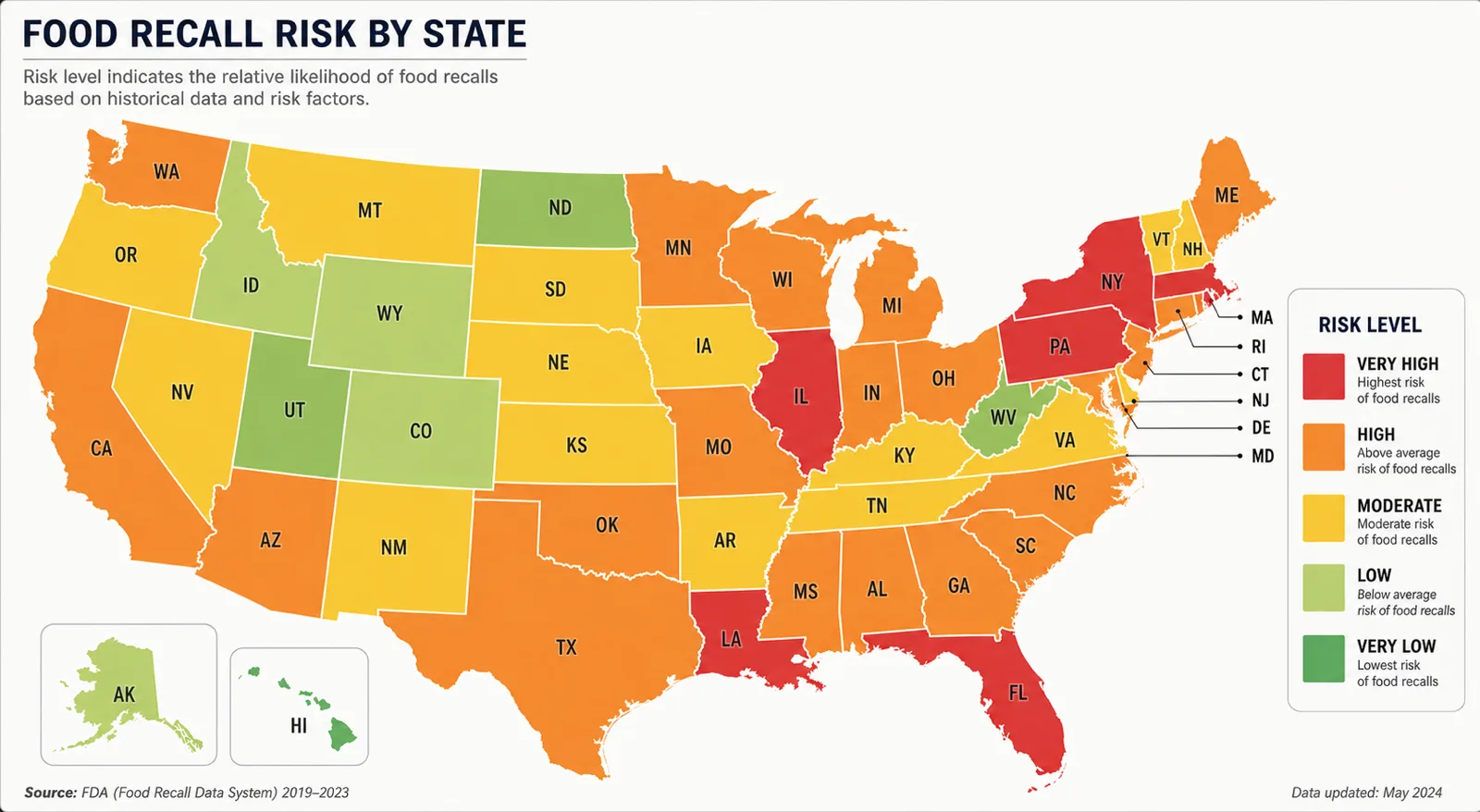
Where you live affects more than your weather and taxes — it may also affect your exposure to food recalls. An analysis of 5-year food recall data reveals that California, New York, and Texas consistently top the list for food recall activity, with California alone associated with 38.3% of recalls (Source: Trace One Analysis).
But does that mean your food is less safe if you live in one of these states? The answer is more nuanced than a simple ranking. Here's a data-driven look at food recalls by state in 2025 and what the geographic patterns really mean.
The Top States for Food Recalls
Based on a Trace One analysis of 5-year food recall trends (2021–2025), the states most frequently associated with food recalls are:
- 1. California — share of recalls: 38.3%
- 2. New York — share of recalls: High (exact % not published)
- 3. Texas — share of recalls: High (exact % not published)
California's dominant position — nearly 4 in 10 recalls — is striking and deserves a closer look.
Why California Leads in Food Recalls
Before panicking about California produce, it's important to understand why the state dominates recall data:
1. California Is America's Agricultural Powerhouse
California produces over a third of the country's vegetables and two-thirds of its fruits and nuts, according to the USDA. More food production means more opportunities for something to go wrong — and more products to recall when it does.
2. Major Food Processing and Distribution Hub
California hosts some of the nation's largest food processing facilities, distribution centers, and ports. Products manufactured or distributed through California reach consumers nationwide. A recall originating from a California facility may affect consumers in all 50 states.
3. Stricter Reporting and Enforcement
California has some of the most rigorous food safety regulations in the country. More testing and enforcement can mean more issues are detected — and thus more recalls are issued. A state that tests less may simply be finding fewer problems.
4. Population Size
As the most populous state with nearly 39 million residents, California has more consumers, more retailers, and more food businesses than any other state.
New York and Texas: The Other Hotspots
New York and Texas round out the top three for similar structural reasons:
- New York is a major import gateway.
- Texas has a large food manufacturing sector.
Both states also have large, diverse populations that consume a wide range of products — increasing the statistical likelihood of being connected to recalls.
What the Geographic Data Actually Tells Us
It's crucial to understand what "food recalls by state" really measures:
What It Means
- The manufacturing or distribution origin of recalled products
- More food production = more potential recalls
- Better enforcement = more detected issues
What It Does NOT Mean
- That food sold in that state is less safe
- That consumers in those states are at greater risk
- That other states are recall-free
In fact, many of the largest recalls in recent years had nationwide distribution. The 2024 BrucePac recall of approximately 12 million pounds of ready-to-eat meat products was distributed across the entire country (Source: USDA FSIS). The 2024 Boar's Head Listeria outbreak affected consumers in 18+ states (Source: USDA FSIS).
The National Impact: By the Numbers
Even if your state doesn't top the recall origination list, you're not immune:
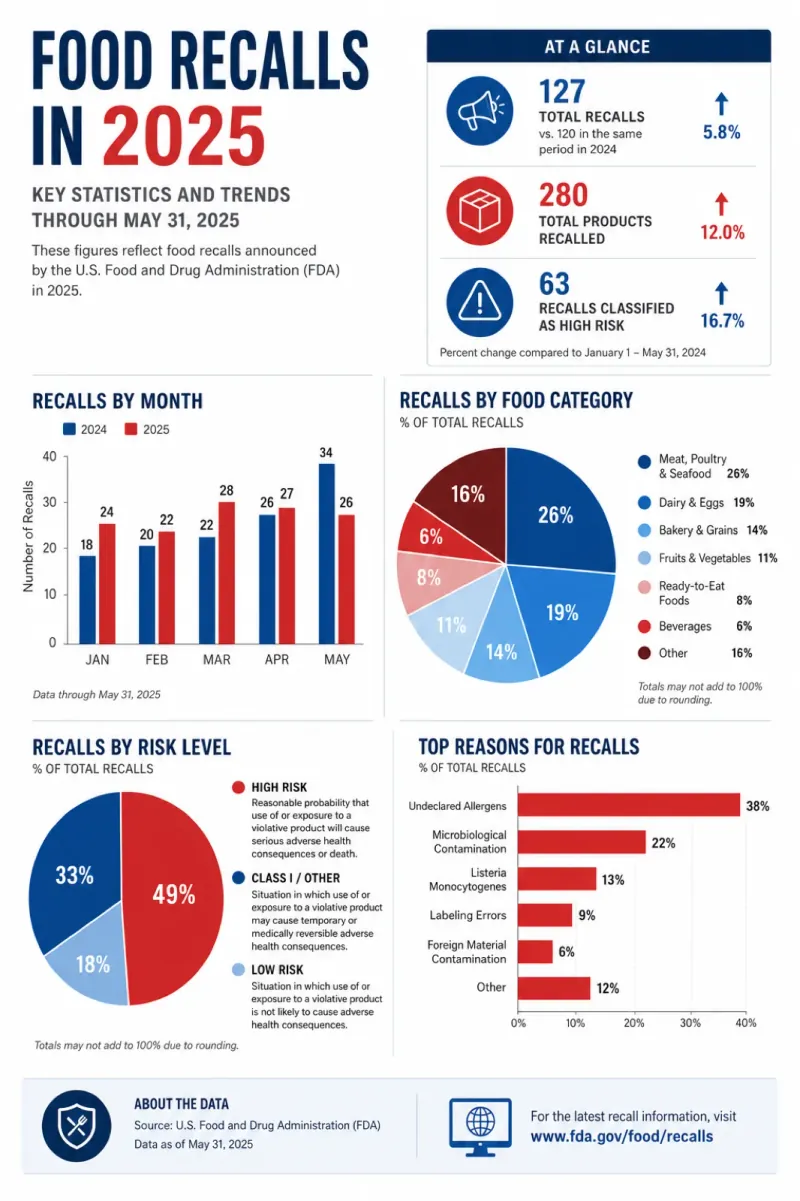
- Total FDA recall events (2025): 251
- Total USDA recalls (2025): 42 (71.4M lbs)
- Estimated total (all sources, 2025): ~613
- Class I recalls (5-year growth): +36.4%
- People sickened (2024): 1,392
With food supply chains stretching across state lines and internationally, a contaminated product manufactured in California can end up on a shelf in Florida, Maine, or anywhere in between — often within days.
Regional Patterns Worth Watching
Beyond the top three states, several regional patterns emerge from the data:
West Coast
High agricultural output and large Asian food import volumes create unique recall profiles. Seafood and produce recalls are particularly common.
Midwest
Meat and poultry processing is concentrated in states like Iowa, Nebraska, and Illinois. USDA recalls disproportionately affect this region.
Southeast
Poultry production (Georgia, Arkansas, Alabama) and seafood (Gulf states) drive regional recall patterns.
Northeast
Import-heavy food supply chain through East Coast ports. Dense urban populations mean more retail touchpoints for recalled products.
The 5-Year Trend: National Recall Growth
Regardless of your state, the national trend affects everyone:
- Total recalls: 505 (2021) → 613 (2025) — 20% increase
- Class I recalls grew 36.4%
- Class II grew 11.2%
- Class III grew 17.1%
In 2024, 1,392 people were sickened by recalled food.
(Source: Trace One Analysis; PIRG Food for Thought 2025)
What This Means for You — Regardless of Your State
Geography matters less than awareness. Whether you live in California or Connecticut, the food in your kitchen could be affected by a recall originating from anywhere.
How to Stay Protected
- Don't assume your state is safe.
- Check both FDA and USDA recall databases.
- Use a recall tracking app.
- Scan your grocery receipts.
We track every one of these recalls in real time — in every state, from every source. Download EatSure to stay ahead.