How to Check If Your Groceries Have Been Recalled
By the EatSure teamPublished 3 min read
On this page
You hear about a food recall on the news. You glance at your fridge. Now what? How do you actually check whether the products in your kitchen are the ones affected?
It's a question more people are asking. In 2025, the FDA and USDA combined for nearly 300 recall events. The USDA's 42 recalls alone covered more than 71 million pounds of food — and 38 of those were Class I, the most serious level, according to USDA FSIS data. But knowing a recall exists is only half the battle. You need to know if your specific purchase is involved.
Here's a step-by-step guide to checking your groceries.
Step 1: Find the Recall Notice
Start at the source:
- FDA recalls: Visit FDA.gov
- USDA recalls
Search by product name, brand, or date. Each recall notice lists the exact products affected, including brand name, product description, package sizes, and distribution area.
Step 2: Check the UPC Code
Every packaged food product has a UPC (Universal Product Code) — the barcode on the packaging. Recall notices almost always include the specific UPC numbers of affected products.
How to check: 1. Find the UPC barcode on your product's packaging (usually on the back or bottom). 2. The number printed below the barcode is your UPC. 3. Compare it to the UPC listed in the recall notice.
If the numbers match, your product may be affected — but you'll also want to check the lot number and dates.
Step 3: Check the Lot Number and Date Codes
A recall rarely covers every unit of a product ever made. It usually applies to specific production runs identified by lot numbers or date codes.
Where to find them:
- Lot numbers are typically printed on the package near the expiration date, often on the bottom, lid, or side seam.
- They may be labeled "LOT," "L," "BATCH," or sometimes just a string of numbers.
Example: In the April 2026 recall of Karns Foods Mini Dark Chocolate Raspberry Cups, only packages with a pack date of September 18, 2025 were affected — roughly 26 to 42 packs distributed through Karns Foods stores in Pennsylvania, according to the FDA.
If your lot number matches the recall notice, stop using the product immediately.
Step 4: Check the Expiration or Best-By Date
Recall notices specify date ranges. For instance, the 2024 BrucePac ready-to-eat meat recall — one of the largest in history at approximately 12 million pounds — covered products with best-by dates from June 19, 2025 through October 2025, per USDA FSIS.
If your product's expiration date falls outside the recall's date range, it's likely not affected. But when in doubt, don't eat it.
Step 5: Check Where You Bought It
Some recalls are limited to specific retailers or states. The RAW FARM E. coli raw cheddar cheese recall in April 2026 initially flagged products sold at Sprouts Farmers Market, H-E-B, and other retailers nationwide. Knowing where you shopped helps narrow things down.
The Easier Way: Let Technology Do the Work
Following those five steps for every recall, every week, is a lot of effort. That's why several apps and tools now exist to automate the process.
The traditional approach — visiting FDA.gov, finding the recall, matching UPC codes and lot numbers — works. But it's slow, manual, and easy to overlook.
Modern recall tracking apps monitor FDA and USDA databases in real time and send you push notifications. But the smartest feature goes further.
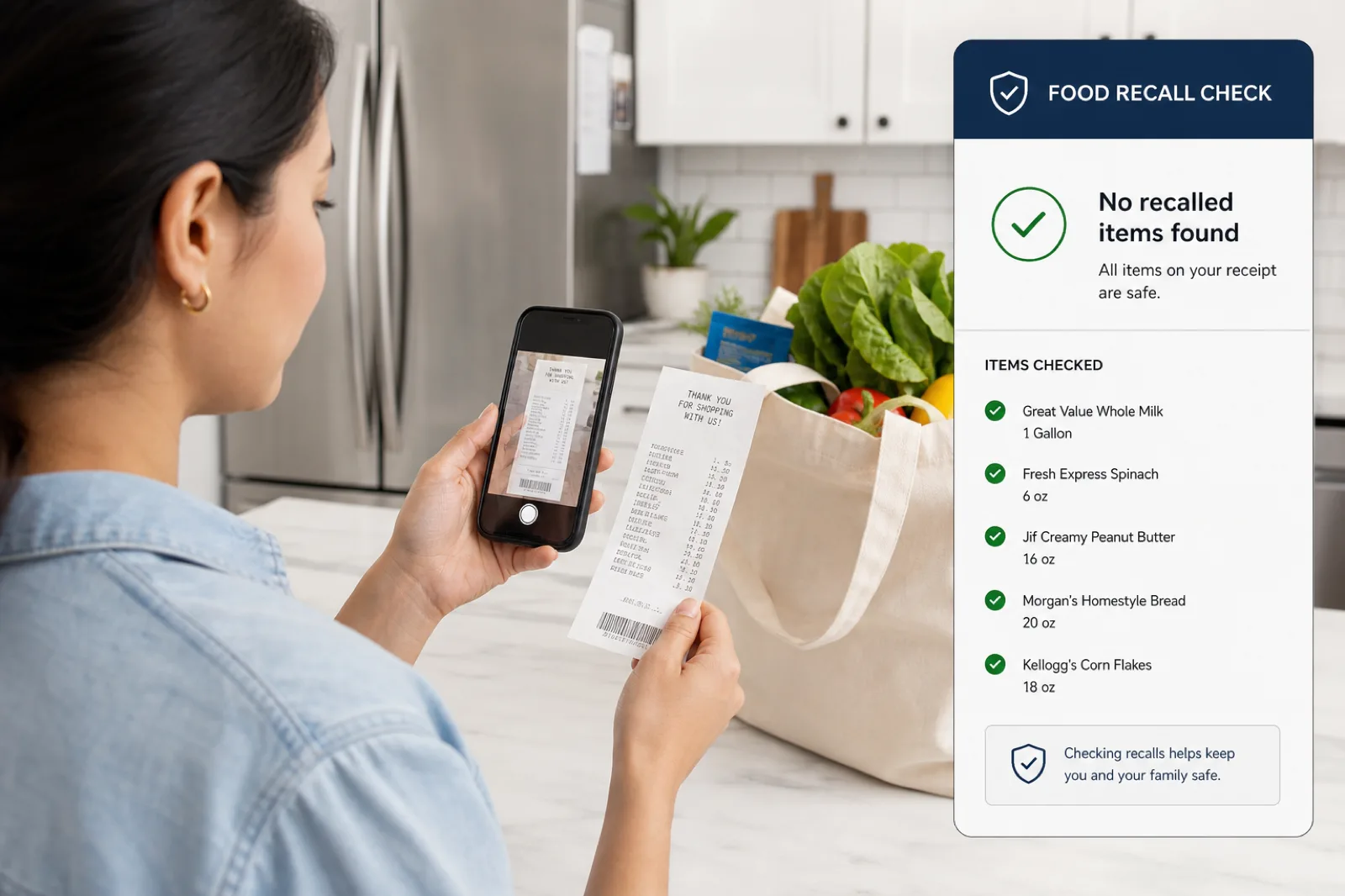
Beyond app alerts, some tools now let you track recalls using your grocery receipts. By uploading a photo of your receipt, the app cross-references every item you purchased against the current recall database — so you know exactly if something sitting in your kitchen right now is affected.
With EatSure, you skip the UPC hunting and lot number squinting.
Snap a photo of your receipt after shopping. The app identifies your purchases and automatically checks them against every active and future recall. If there's a match, you get a clear, specific notification telling you exactly which product is affected and what to do.
What to Do If Your Product Is Recalled
- Stop using the product immediately. Don't taste it to check.
- Check for symptoms if you've already consumed it.
- Follow the recall notice instructions.
- Contact your doctor if you or a family member feels ill.
See if anything in your fridge is recalled right now — download EatSure and scan your latest grocery receipt.