How to Get Notified About Food Recalls Automatically
By the EatSure teamPublished 3 min read
On this page
Every week, the FDA publishes roughly five new food recall notices. In 2025 alone, there were 251 FDA food and beverage recall events, according to an analysis by Esko/GlobalVision. That's a lot of potentially dangerous products quietly pulled from shelves — and most people never hear about them until it's too late.
So how do you actually stay in the loop? Let's walk through the options, from the old-school approach to smarter, more modern solutions.
The Traditional Method: Manually Checking FDA.gov and USDA.gov
The most basic way to track food recalls is to visit the official government websites yourself:
- FDA Recalls & Safety Alerts
- USDA FSIS Recall Case Archive (fsis.usda.gov/recalls)
You can bookmark these pages and check them regularly. The FDA also offers an email subscription service where you receive weekly summaries of recall notices.
The Problem With Manual Checking
Here's the issue: there are hundreds of recalls every year. In 2025, the USDA alone issued 42 recalls covering more than 71 million pounds of food products. Most of those were classified as Class I — the most serious category, meaning there's a reasonable chance the product could cause serious health problems or death.
Unless you check these websites every day, you're likely to miss something. And even when you do check, the recall notices are written in technical language full of lot numbers, UPC codes, and distribution details. It's hard to figure out whether a recall actually affects you.
FDA and USDA Email Alerts: A Step Up
Both the FDA and USDA offer email notification services:
- FDA Safety Alerts: You can subscribe to email updates.
- USDA FSIS Alerts: You can sign up for FSIS recall notifications.
These are free and helpful, but they come with limitations. The emails are broad — you'll get notified about every recall, whether it's a product sold only in Pennsylvania or one that was nationwide. There's no way to filter by what you actually buy or where you shop.
The Modern Approach: Automated Recall Alert Apps
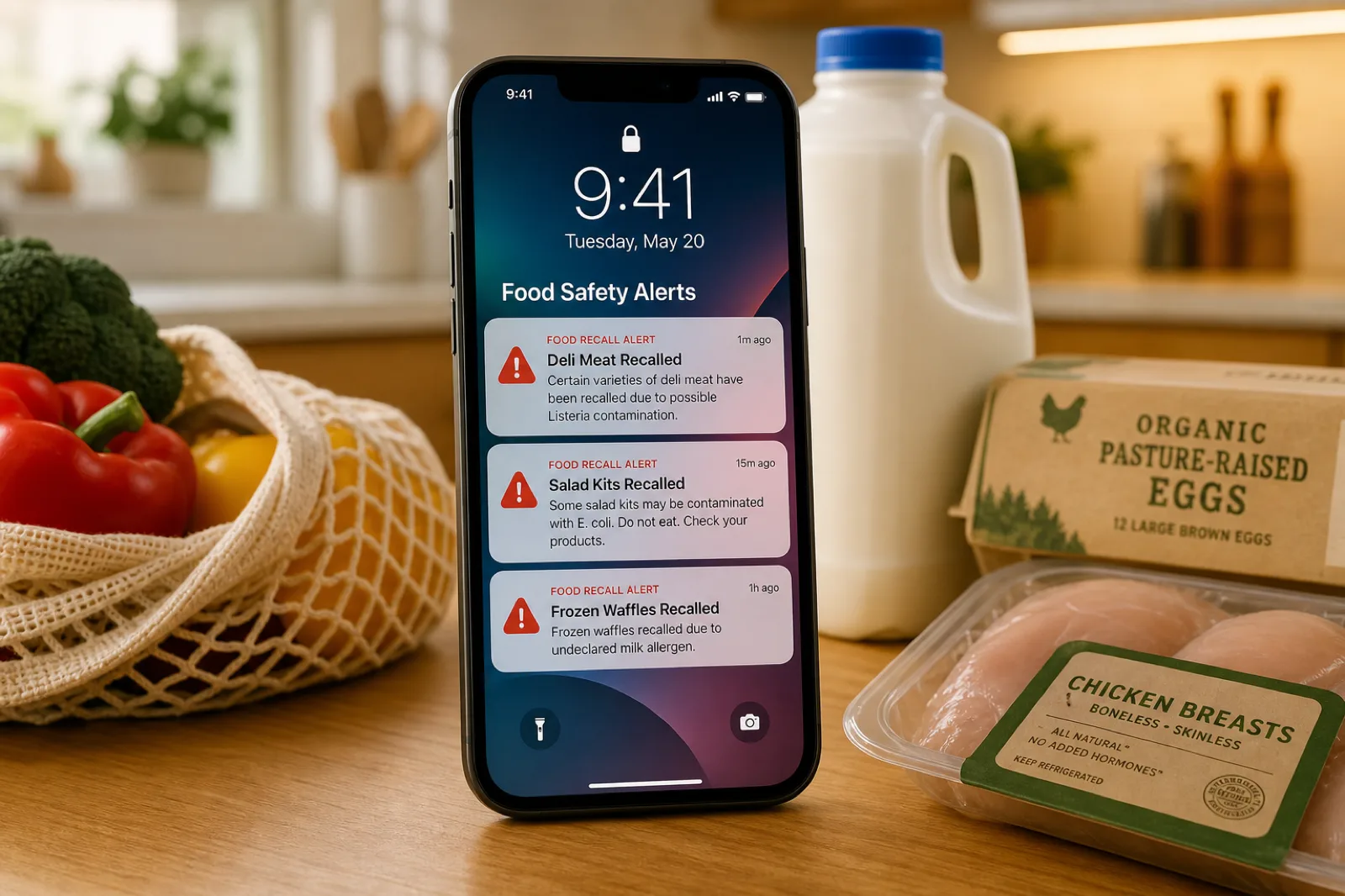
Today, several apps and tools exist that go beyond government email lists. These services monitor FDA and USDA recall databases in real time and push notifications directly to your phone when a new recall is announced.
The benefit? You don't have to remember to check anything. The moment the FDA or USDA publishes a recall, you get a push notification — often within minutes.
Some of these tools also let you filter alerts by product category, dietary concerns (like allergens), or geographic region so you only see what's relevant to you.
Why This Matters: Speed Saves Lives
Consider the 2024 Boar's Head Listeria outbreak. That recall, involving deli meats distributed across 18+ states, was linked to 10 deaths and dozens of hospitalizations, according to USDA FSIS. The gap between contamination and public awareness is often days or even weeks. In March 2026, RAW FARM initially declined the FDA's recommendation to recall their E. coli-contaminated raw cheddar cheese on March 15 — the recall wasn't initiated until April 2, more than two weeks later.
Automatic alerts close that gap.
The Next Level: Receipt Scanning
Beyond app alerts, some tools now let you track recalls using your grocery receipts. By uploading a photo of your receipt, the app cross-references every item you purchased against the current recall database — so you know exactly if something sitting in your kitchen right now is affected.
This is a game-changer for a simple reason: most recalls are announced after you've already bought the product. You're not standing in the store reading recall notices. You're at home, and the food is already in your fridge.
With EatSure, you can snap a photo of your receipt after each grocery trip. If any product you purchased is later recalled, you get an immediate, personalized alert — not a generic notification about a product you may or may not have bought, but a specific "Hey, that cheese you bought on Tuesday has been recalled."
How to Set Up Automatic Food Recall Notifications Today
- Start with the basics: Subscribe to FDA and USDA email alerts.
- Download a recall alert app: Look for one that monitors both FDA and USDA recall databases.
- Enable push notifications.
- Use receipt scanning: Upload your grocery receipts.
See if anything in your fridge is recalled right now — download EatSure and scan your latest receipt.