How to Know If Something You Already Bought Was Recalled
By the EatSure teamPublished 4 min read
On this page
Here's the uncomfortable truth about food recalls: by the time a product is officially recalled, you may have already bought it, opened it, and served it to your family.
This isn't a rare edge case. It's how most recalls work. The contamination happens during production. The product ships to stores. People buy it. Days, weeks, or even months later, the FDA or USDA announces a recall. In the worst cases, people have already gotten sick before the recall is made public.
In 2024, 1,392 people were sickened by recalled food, according to PIRG's "Food for Thought" report — up from 1,118 the year before. And that's just the confirmed cases.
So how do you find out if something already in your kitchen has been recalled?
The Core Problem: The Timeline Gap
Food recalls are reactive, not preventive. Here's a typical timeline:
- A product is manufactured and shipped.
- It arrives at stores and consumers buy it.
- Reports of illness come in, or routine testing finds contamination.
- The FDA or USDA investigates.
- A recall is announced — days to weeks after the problem started.
Sometimes, the gap is even longer. During the RAW FARM E. coli O157:H7 raw cheddar cheese outbreak in 2026, the FDA recommended a recall on March 15. The company didn't initiate the recall until April 2 — an 18-day delay while contaminated cheese was being sold and consumed. Nine people fell ill, three were hospitalized, and one child developed a serious kidney condition called hemolytic uremic syndrome, according to the FDA.
The BrucePac recall in October 2024 covered approximately 12 million pounds of ready-to-eat meat and poultry products, with best-by dates stretching months into the future. That means many consumers had these products sitting in their freezers, with no idea they were potentially contaminated with Listeria.
The Traditional Check: Dig Through Your Kitchen
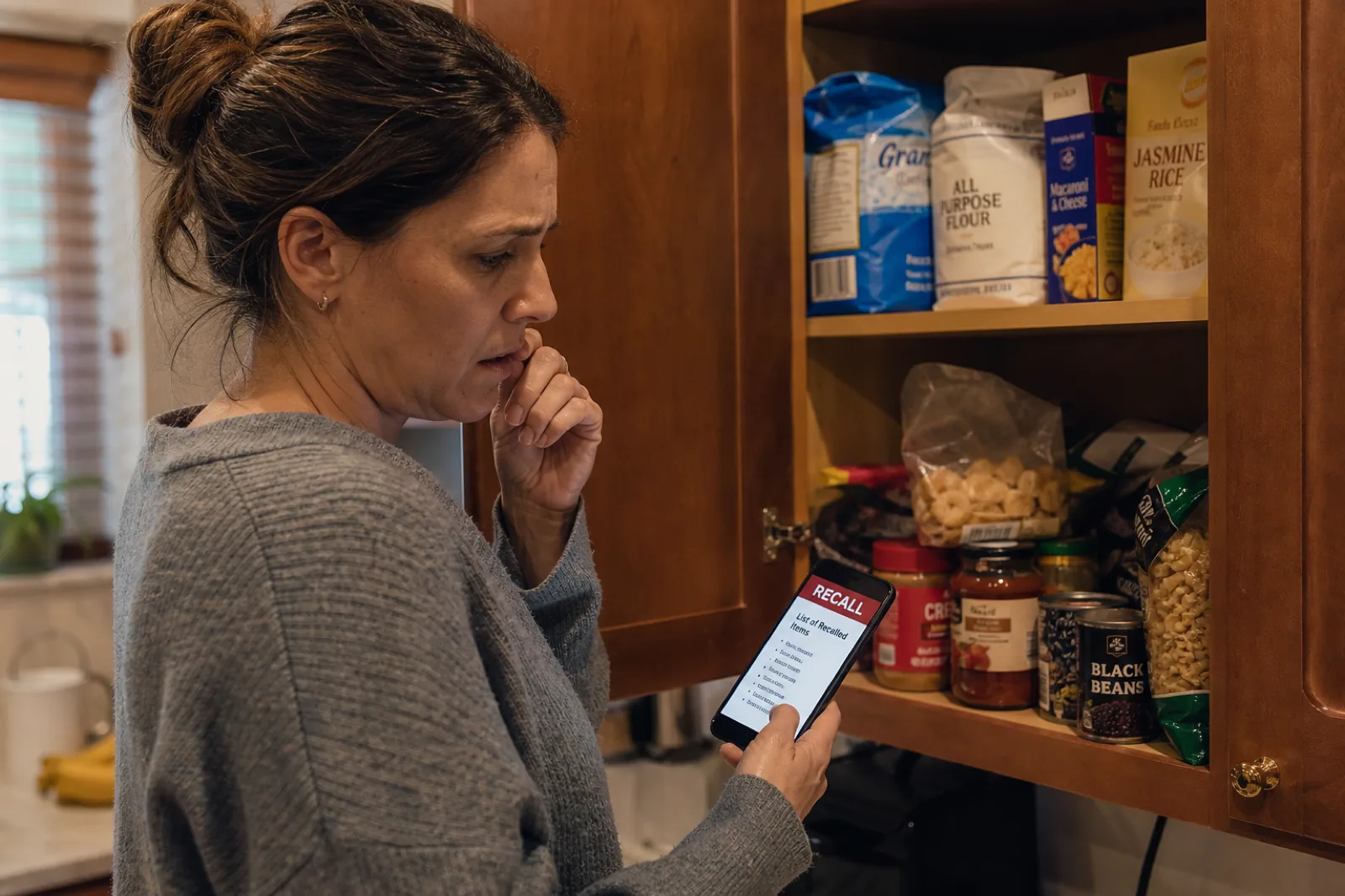
If you hear about a specific recall, here's what to do manually:
- Read the recall notice on FDA.gov or FSIS.USDA.gov.
- Check your fridge, freezer, and pantry. Look at product labels.
- Check your trash or recycling.
- Think about where you shopped.
This works if you hear about a recall and take immediate action. But it depends on two things: that you hear about it in the first place, and that you still have the packaging.
The Problem With the Manual Approach
The manual method fails in several common scenarios:
- You already threw away the packaging.
- You didn't hear about the recall.
- The recall was small and regional.
- You can't remember exactly what you bought.
The Modern Solution: Receipt-Based Recall Tracking
Beyond app alerts, some tools now let you track recalls using your grocery receipts. By uploading a photo of your receipt, the app cross-references every item you purchased against the current recall database — so you know exactly if something sitting in your kitchen right now is affected.
This directly solves the timeline problem. You don't need to keep packaging. You don't need to remember what you bought. You don't need to manually check UPC codes. Your receipt is the record, and the app does the matching.
How It Works With EatSure
- After grocery shopping, open EatSure and snap a photo of your receipt.
- The app reads and logs every item on the receipt.
- Your purchases are continuously checked against FDA and USDA recall databases.
- If a product you bought is recalled — even weeks after your purchase — you get an alert.
- The alert tells you which product, when you bought it, and exactly what to do.
This is the critical difference: traditional alerts tell you a product exists somewhere on shelves. Receipt tracking tells you that product is in your home.
Why This Changes Everything
Think about the Boar's Head Listeria outbreak of 2024. Deli meats were sold across 18+ states before the recall. Ten people died. Dozens were hospitalized. Many of those affected had purchased the products days or weeks before anyone knew there was a problem.
Now imagine you'd scanned your receipt from the deli counter that week. The moment the recall was announced, you'd have received an alert: "The Boar's Head liverwurst you purchased on [date] has been recalled due to Listeria contamination. Do not eat it. Return it for a refund or discard immediately."
That's the difference between finding out too late and finding out in time.
Protect Yourself Going Forward
You can't go back and un-buy something. But you can make sure you find out about it fast:
- Start scanning receipts now.
- Enable push notifications so alerts reach you immediately.
- Check your kitchen whenever you see a recall.
- When in doubt, throw it out.
The number of food recalls is rising — total recalls grew 20% from 2021 to 2025, with Class I (most serious) recalls up 36.4%, according to Trace One analysis. The system isn't slowing down. Your best defense is being informed the moment a recall is announced.
See if anything in your fridge is recalled right now — download EatSure and scan your latest receipt.