Most Common Causes of Food Recalls: The 2025 Report
By the EatSure teamPublished 4 min read
On this page
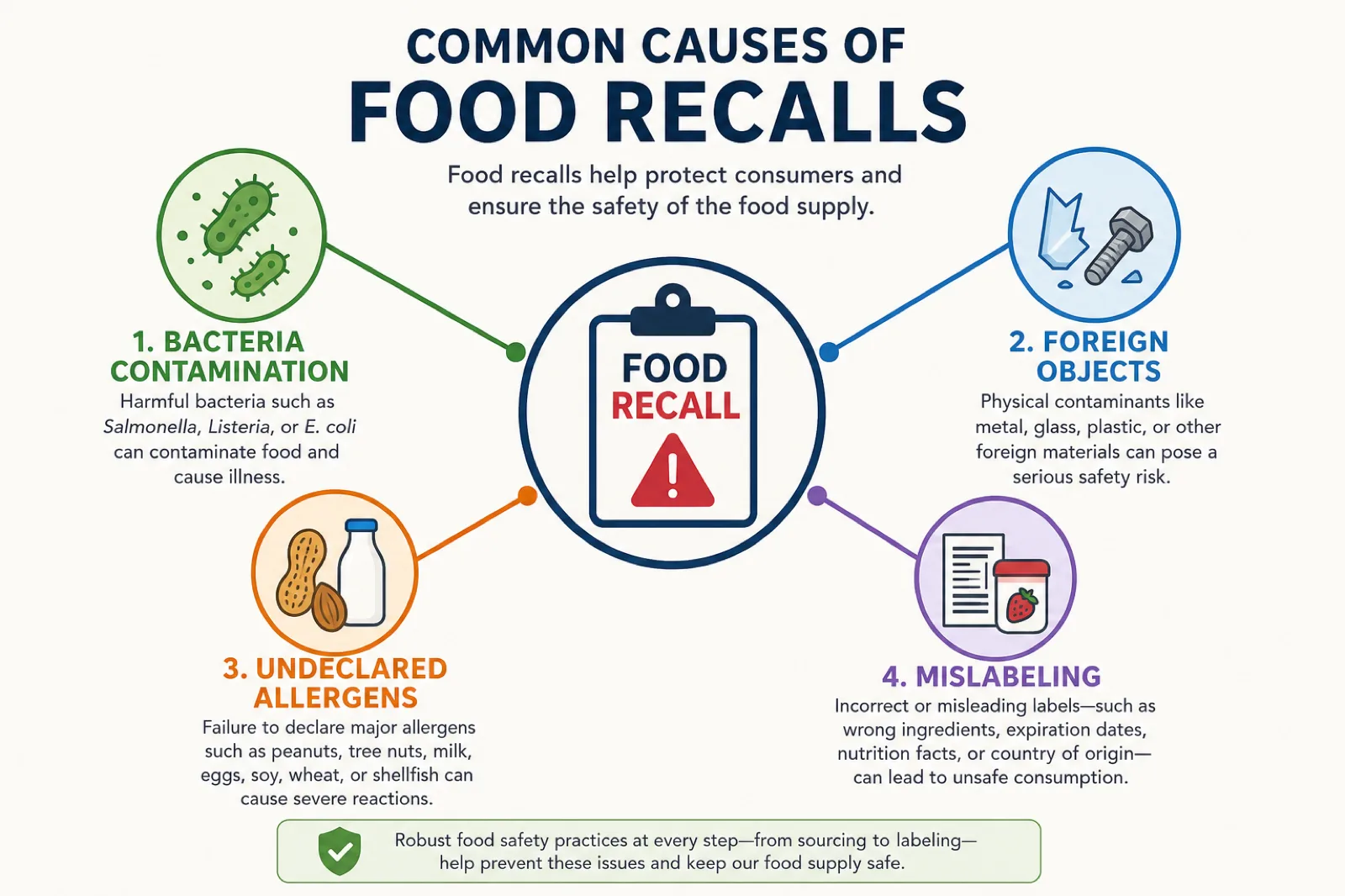
What makes a food company pull its products from shelves? In 2025, the answer was overwhelmingly one of three things: wrong labels, dangerous bacteria, or stuff that shouldn't be in food. A deeper look at the data shows exactly how these common causes of food recalls shaped a record-breaking year for food safety.
Using official data from the FDA's 251 recall events and the USDA's 42 recall actions, here is a comprehensive breakdown of what went wrong in 2025 — and what it means for the food on your table.
1. Undeclared Allergens: The Dominant Cause at 45.8%
For anyone with food allergies, 2025 was an especially alarming year.
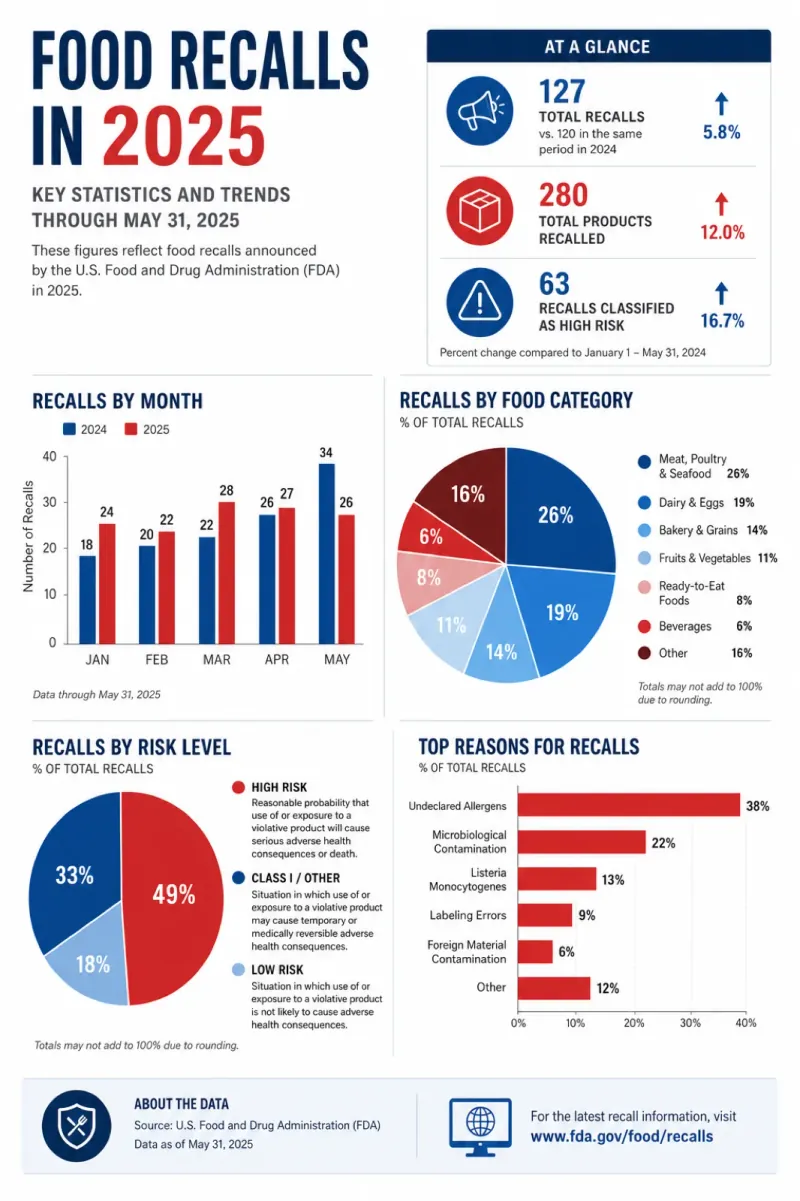
Allergen mislabeling accounted for 115 of the FDA's 251 food recall events — 45.8% of the total (Source: Esko/GlobalVision analysis of FDA data).
This happens when a food product contains an allergen — like milk, peanuts, or tree nuts — that isn't listed on the label. For the estimated 33 million Americans with food allergies, eating even a trace amount can trigger a life-threatening anaphylactic reaction.
Which Allergens Were Missed Most?
- Milk/dairy: ~30% of all allergen recalls (the most common)
- Tree nuts: Second most common
- Wheat: Third
- Peanuts: Fourth
- Sesame: Growing concern
- Soy: Also frequently undeclared
On the USDA side, undeclared allergens caused 9 of 42 meat and poultry recalls — the second-leading cause behind foreign material.
Why Does This Keep Happening?
Allergen mislabeling isn't usually deliberate. Common causes include:
- Shared production lines where allergens transfer
- Packaging errors where the wrong label goes on the wrong product
- Ingredient supplier mistakes
- Recipe changes that aren't reflected on updated labels
A real example: In April 2026, Karns Foods recalled Mini Dark Chocolate Raspberry Cups because they contained undeclared peanuts due to a "temporary breakdown in packaging processes" (Source: FDA.gov). Only 26–42 packs were affected, but for someone with a peanut allergy, even one pack could be deadly.
2. Foodborne Illness: 37.5% of FDA Recalls
Bacterial and pathogen contamination was the second-leading cause of FDA food recalls in 2025, responsible for 94 recall events (37.5%).
These recalls are almost always classified as Class I — the most serious level — because the health consequences can be severe or fatal.
The Big Three Pathogens
- Listeria monocytogenes — FDA recalls in 2025: 42. Key fact: Caused most outbreak-related deaths.
- Salmonella — FDA recalls in 2025: 35. Key fact: Responsible for 63% of foodborne illness outbreaks.
- E. coli / C. botulinum — FDA recalls in 2025: Remaining. Key fact: Includes serious strains like O157:H7.
Salmonella was the single most common cause of foodborne illness outbreaks in 2025, linked to 63% of all outbreaks investigated.
However, Listeria monocytogenes — while causing fewer total illnesses — was responsible for the greatest number of outbreak-related deaths (Source: FDA; CDC).
The deadliness of Listeria was demonstrated in the 2024 Boar's Head outbreak, which killed 10 people across 18+ states and led to follow-up recalls extending into 2025 (Source: USDA FSIS).
3. Chemical and Radiological Contamination: 10.4%
An often-overlooked category, chemical and radiological hazards caused 26 FDA recall events (10.4%) in 2025. The most notable case: a cluster of 11 separate recalls tied to Cesium-137 contamination in frozen shrimp products.
Chemical contamination can include pesticide residues, cleaning agents, unauthorized additives, or heavy metals. While less common than allergen and pathogen issues, these recalls are growing in complexity.
4. Foreign Objects: A Leading USDA Concern
Items that have no business being in food — plastic, glass, metal, stones, and wood — caused:
- 9 FDA recalls (3.6%)
- 13 USDA recalls — making foreign material the #1 cause
Foreign objects pose choking hazards and can cause cuts, broken teeth, or internal injuries. In meat processing, metal fragments from equipment breakdowns are a common source.
5. Other Causes: Production and Import Violations
The USDA also flagged recalls for less commonly discussed reasons:
- Production without federal inspection: 7 recalls
- Import violations: 5 recalls
- Unapproved substances: 2 recalls
These speak to oversight gaps in the food supply chain, particularly with smaller producers and imported goods.
The 5-Year Trend: It's Getting Worse
The causes of food recalls haven't just stayed the same — they've intensified:
- Total recalls rose from 505 in 2021 to 613 in 2025 (20%)
- Class I recalls grew 36.4% — the most dangerous are increasing
In 2024 alone, 1,392 people were sickened by recalled food products, up from 1,118 in 2023 (Source: PIRG Food for Thought 2025).
What You Can Do Right Now
Understanding the most common causes of food recalls puts you in a stronger position to protect your household:
- Always read labels carefully, especially if you have food allergies.
- Check the FDA and USDA recall pages at least weekly.
- Use a recall tracking tool.
- Scan your receipts.
We track every one of these recalls in real time. Download EatSure to stay protected.