Class I vs. Class II vs. Class III Food Recalls Explained
By the EatSure teamPublished 4 min read
On this page
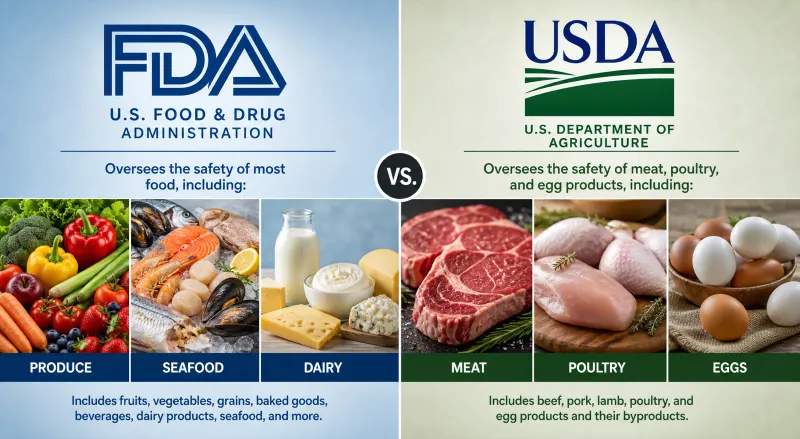
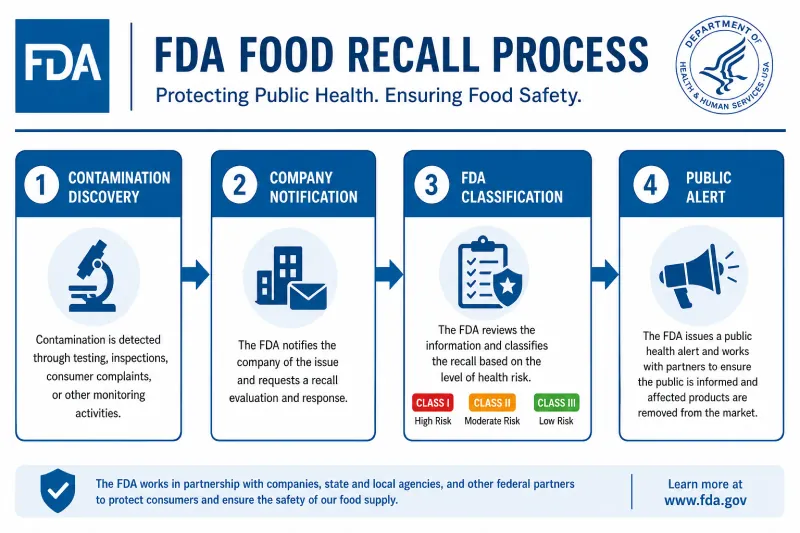
Not all food recalls are created equal. When the FDA or USDA announces a recall, they assign it a classification — Class I, Class II, or Class III — based on the level of health risk. Understanding what these food recall classifications mean helps you quickly decide how urgently you need to act.
In recent years, the most serious type of recall has been increasing. A Trace One analysis of five-year trends (2021–2025) found that Class I recalls grew by 36.4%, outpacing both Class II (up 11.2%) and Class III (up 17.1%). Here is what each class means, with real examples to put it in perspective.
What Is a Class I Food Recall?
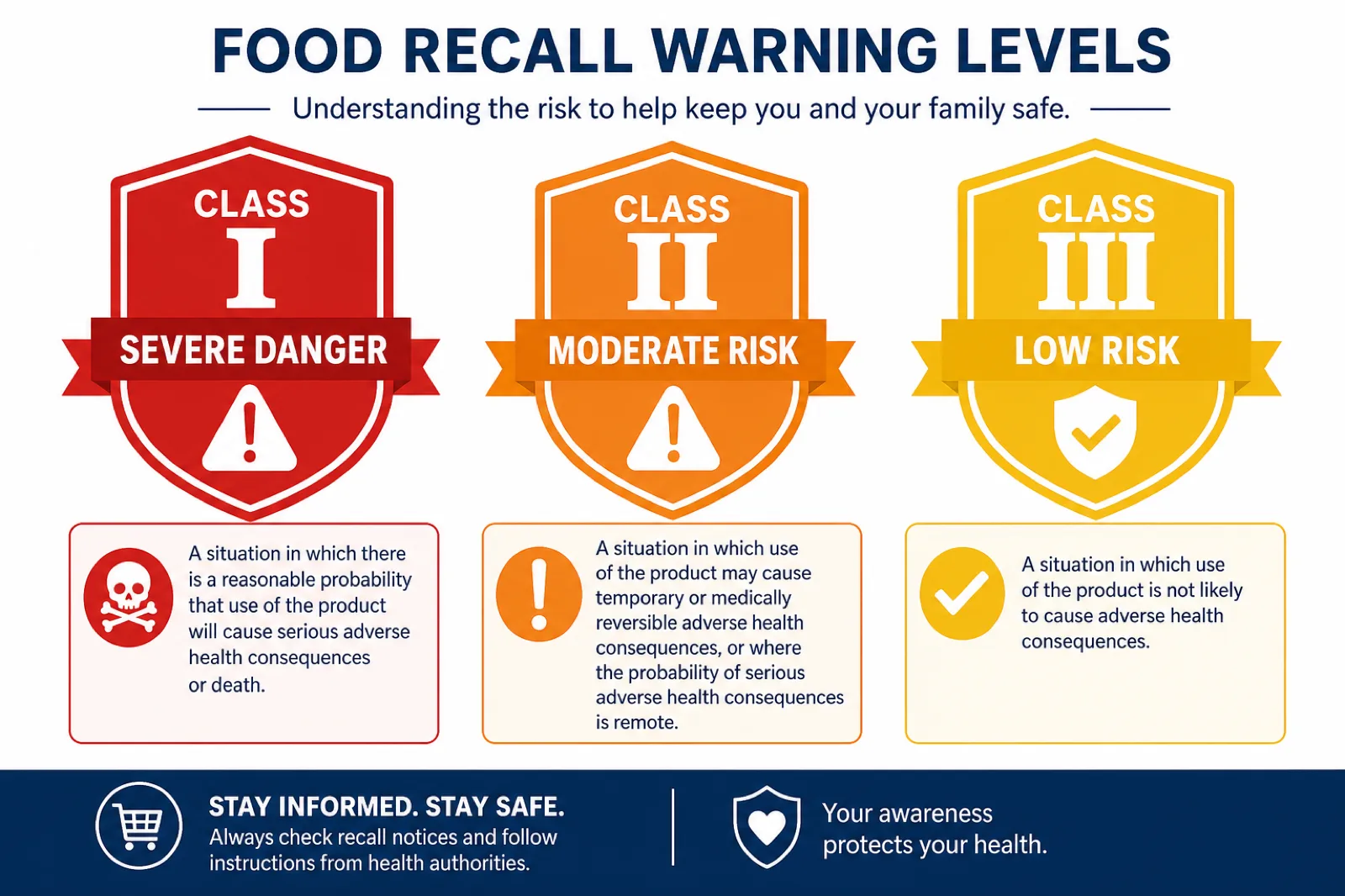
Class I is the most serious classification. It means there is a reasonable probability that eating the food will cause serious adverse health consequences or death.
These recalls typically involve:
- Dangerous pathogens like Listeria monocytogenes, Salmonella, or E. coli O157:H7
- Undeclared allergens that could trigger life-threatening anaphylaxis
- Harmful chemical contamination
Class I recalls demand immediate action. If you have the product at home, you should stop eating it right away and either throw it out or return it for a refund.
Real Class I Examples
- Boar's Head Listeria Recall (2024): The USDA recalled Boar's Head liverwurst and other deli meats after Listeria monocytogenes contamination was confirmed. The outbreak resulted in 10 deaths and dozens of hospitalizations across 18 or more states — making it one of the deadliest food outbreaks in recent years (source: USDA FSIS).
- RAW FARM E. coli O157:H7 Cheese (2026): The FDA classified the recall of RAW FARM raw cheddar cheese as Class I after E. coli O157:H7 was linked to 9 illnesses — over half in children under 5. Three people were hospitalized and one developed hemolytic uremic syndrome (HUS), a potentially life-threatening kidney condition (source: FDA.gov).
- BrucePac Ready-to-Eat Meats (2024): Approximately 12 million pounds of ready-to-eat meat and poultry were recalled — one of the largest meat recalls in U.S. history — due to possible Listeria contamination (source: USDA FSIS).
In 2025, 38 out of 42 USDA recalls (covering over 71 million pounds of food) were classified as Class I (USDA FSIS annual summary).
What Is a Class II Food Recall?
Class II means that eating the food may cause temporary or medically reversible health problems, or that the probability of serious health consequences is remote.
These recalls are still worth acting on, but the risk is lower. They often involve:
- Minor bacterial contamination at low levels
- Undeclared allergens in trace amounts where the risk of severe reaction is lower
- Labeling errors that could affect people with specific dietary restrictions
- Quality issues that may cause short-term digestive discomfort
Understanding Class II in Context
Class II recalls are common but receive far less media attention than Class I events. A product recalled for containing small amounts of an undeclared ingredient that is not one of the major allergens might fall into this category. Similarly, a product with mild bacterial contamination below the level likely to cause serious illness might be classified as Class II.
While these situations are less immediately dangerous, they can still affect vulnerable populations — including young children, pregnant women, elderly individuals, and immunocompromised people. If you fall into any of these groups, treat Class II recalls with the same urgency as Class I.
What Is a Class III Food Recall?
Class III means that eating the food is not likely to cause any adverse health consequences.
These recalls are the least serious and often involve:
- Minor labeling errors (wrong weight, missing nutritional information)
- Quality issues that do not affect safety
- Packaging defects that do not compromise the food
Class III recalls generally do not require urgent action, but you may still be entitled to a refund or replacement.
Why Class III Recalls Still Matter
Even though the health risk is minimal, Class III recalls can signal broader quality-control problems at a manufacturer. A company that makes a labeling error today may have more serious issues tomorrow. Tracking all recall classes helps you make informed decisions about which brands you trust.
How Recall Classification Affects What You Should Do
- Class I — Health risk: Serious harm or death possible. Your action: Stop eating immediately. Discard or return. Check if others in household consumed it.
- Class II — Health risk: Temporary or reversible problems. Your action: Stop eating. Return for refund. Monitor for symptoms.
- Class III — Health risk: Unlikely adverse effects. Your action: Return if desired. No urgent health action needed.
The Trend: Class I Recalls Are Rising
According to Trace One's analysis of recall data from 2021 to 2025, total food recalls rose from 505 to 613 — a 20% increase. But the most concerning trend is within that data:
- Class I recalls grew 36.4%
- Class II recalls grew 11.2%
- Class III recalls grew 17.1%
The fastest-growing category is the most dangerous one. This means more products posing serious health risks are reaching consumers. Nearly half (45.2%) of all recalls during this period were caused by allergen contamination, and 22.6% were caused by bacterial contamination (Trace One, 2021–2025).
How to Stay Protected Across All Recall Classes
The FDA and USDA do not send you personal alerts based on what you have purchased. Their recall pages list every event, and it is up to you to check whether your products are affected.
EatSure tracks recalls across all three classes from both the FDA and USDA and alerts you in real time. With the receipt-scanning feature, you can upload your grocery receipts and have every item cross-referenced against the current recall database — so you know right away if a Class I, II, or III recall affects something already in your kitchen.
Knowing the difference between recall classes helps you make smart decisions. Having a tool that watches for all of them means you never have to worry about missing one.