FDA vs. USDA Recalls: What's the Difference?
By the EatSure teamPublished Updated 3 min read
On this page
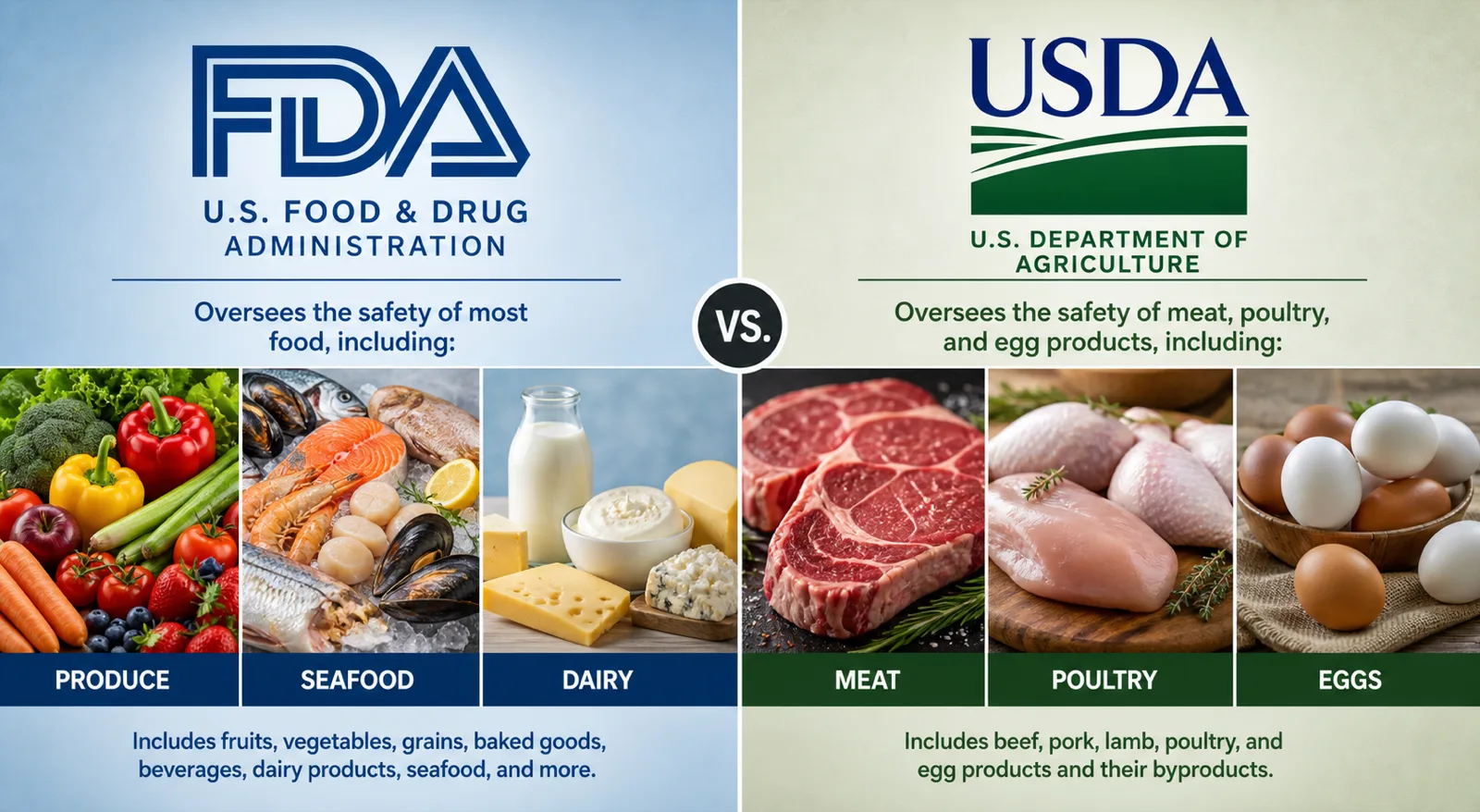
When you hear about a food recall, you might assume there is one government agency in charge. There isn't. In the United States, food safety oversight is split between two major agencies: the Food and Drug Administration (FDA) and the United States Department of Agriculture (USDA). Understanding the difference between FDA and USDA recalls is essential if you want to track the foods that actually affect you.
This split can be confusing — and it sometimes leaves gaps in how quickly consumers are notified. Here is how the two systems work, what each agency covers, and why it matters for your family's safety.
Who Handles What: The Jurisdiction Split
The division is based on the type of food product:
FDA (Food and Drug Administration)
The FDA oversees roughly 80% of the U.S. food supply, including:
- Fruits and vegetables
- Seafood and fish
- Dairy products
- Packaged foods and beverages
- Bakery items
- Dietary supplements
- Infant formula
- Pet food
In 2025, the FDA recorded 251 food and beverage recall events — roughly five per week (Esko/GlobalVision analysis). The top cause was allergen mislabeling, accounting for 45.8% of all FDA recalls, followed by foodborne illness at 37.5%.
USDA (United States Department of Agriculture)
The USDA's Food Safety and Inspection Service (FSIS) oversees:
- Meat (beef, pork, lamb)
- Poultry (chicken, turkey)
- Processed egg products (liquid eggs, dried eggs)
- Catfish
In 2025, USDA FSIS recorded 42 recalls totaling over 71.4 million pounds of food. Thirty-eight of those recalls — covering more than 71 million pounds — were classified as Class I, the most serious category (source: USDA FSIS annual summary).
Why Two Agencies? A Brief History
The split dates back to the early 1900s. The USDA was given authority over meat inspection with the Federal Meat Inspection Act of 1906, while the FDA's role expanded through the Federal Food, Drug, and Cosmetic Act of 1938. Over the decades, Congress added poultry and egg products to the USDA's jurisdiction while leaving nearly everything else with the FDA.
The result is a system where a cheese pizza is regulated by the FDA, but a pepperoni pizza is regulated by the USDA — because it contains meat.
This can create confusion for both consumers and companies.
Real Examples: FDA Recalls vs. USDA Recalls
FDA Recall Example: RAW FARM E. coli Cheese (2026)
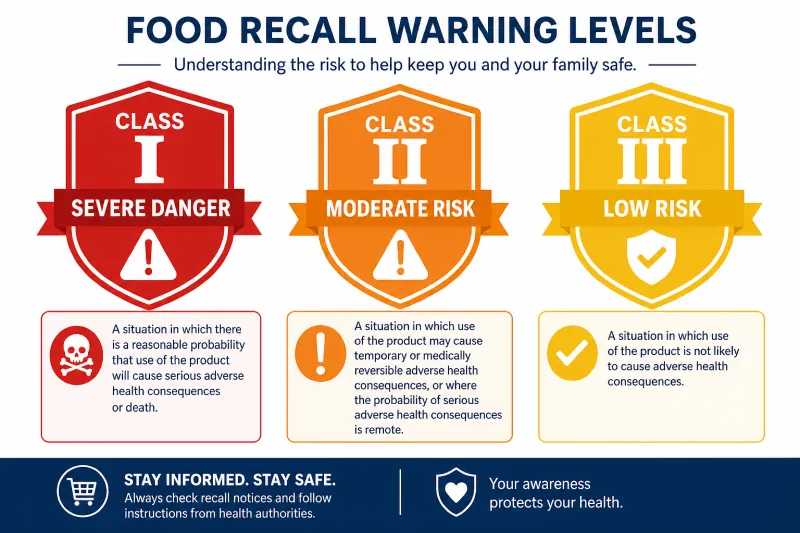
In March–April 2026, the FDA oversaw the recall of RAW FARM brand raw cheddar cheese due to E. coli O157:H7 contamination. Nine people were sickened across California, Florida, and Texas, with three hospitalizations. Over half of the illnesses occurred in children. The recall was classified as Class I (source: FDA.gov).
FDA Recall Example: Karns Foods Undeclared Peanuts (2026)
Also in April 2026, Karns Foods voluntarily recalled Mini Dark Chocolate Raspberry Cups due to undeclared peanuts — a serious allergen risk.
Only 26 to 42 packs were affected, all distributed through Karns Foods locations in Pennsylvania. No illnesses were reported (source: FDA.gov).
USDA Recall Example: Boar's Head Listeria (2024)
The USDA's FSIS oversaw the massive 2024 Boar's Head recall after Listeria monocytogenes was found in liverwurst and other deli meats.
This became one of the deadliest food outbreaks in recent years, with 10 deaths and dozens of hospitalizations across 18 or more states (source: USDA FSIS).
USDA Recall Example: BrucePac Listeria (2024)
In October 2024, USDA FSIS announced a recall of approximately 12 million pounds of BrucePac ready-to-eat meat and poultry products due to possible Listeria contamination — one of the largest meat recalls in U.S. history (source: USDA FSIS).
Key Differences in How They Handle Recalls
- Products covered — FDA: ~80% of food supply; USDA FSIS: Meat, poultry, egg products
- 2025 recall events — FDA: 251; USDA FSIS: 42
- Top recall cause (2025) — FDA: Allergen mislabeling (45.8%); USDA FSIS: Foreign materials (13 recalls)
- Mandatory recall authority — FDA: Yes (since FSMA, 2011); USDA FSIS: No (recalls are voluntary, though FSIS can detain and seize products)
- Continuous inspection — FDA: No (periodic); USDA FSIS: Yes (inspectors present in plants)
One major distinction: USDA inspectors are present in every meat and poultry processing plant during operation. The FDA, on the other hand, inspects facilities periodically. This difference affects how quickly problems are detected.
Updates since publication
Correction: an earlier version of the comparison table said USDA FSIS has mandatory recall authority. It does not. Meat, poultry and egg product recalls are voluntary, although FSIS can detain and seize products. The FDA gained mandatory recall authority for the foods it oversees under the Food Safety Modernization Act in 2011.